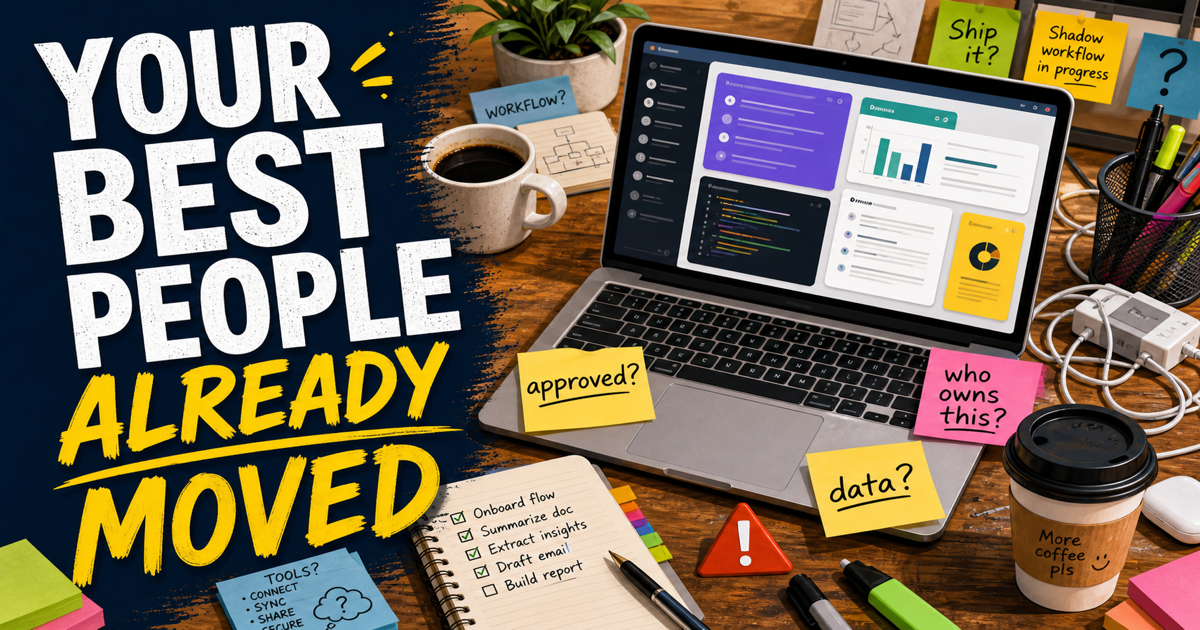
I saw a post earlier that nailed something I have been thinking about for a while: The most AI-driven employees are already paying for the best tools out of pocket. If the company does not provide those tools, those same employees may end up putting company work into personal AI accounts.
My first reaction was: of course they are. That does not mean it is always right. It does not mean you can throw sensitive data into whatever tool has the best demo video this week. But it does mean companies need to stop pretending this is some future problem they can schedule a committee around. The serious people already moved.
The Company Is Moving Too Slow
I get why companies move slower than individual contributors. Owners and CEOs have more to think about. They have risk, cost, policy, security, client expectations, existing software, departments, workflows, legal concerns, and a hundred other things sitting on their desk. They cannot just chase every shiny tool because somebody on the team saw a good demo and got fired up.
That explains why they move slower. It does not excuse pretending AI does not exist.
The worst response right now is silence. Ignoring it. Not doing the research. Not understanding the tools. Not talking to the team. Not asking who is already using AI and how. Because somebody is already using it. Maybe a lot of people are. If leadership does not create a path, the team will create one without them. That is where the risk starts.
And that risk is not some abstract scary word you put in a slide deck. It shows up in normal work. Somebody summarizes a client email in a personal account. Somebody pastes a messy internal doc into a tool because they need a cleaner version before the meeting. Somebody uses AI to rewrite a proposal, debug code, compare spreadsheets, or make sense of meeting notes. Most of the time, they are not trying to be sneaky. They are trying to get unstuck.
But if nobody has explained what is allowed, every employee is left to draw their own line. That means five people may have five different standards for what counts as sensitive. One person thinks names are fine but numbers are not. Another thinks anything already in email is fair game. Another thinks if the tool says "enterprise" somewhere on the website, it must be safe.
That is how shadow workflows become data risk. Not because everyone is reckless. Because leadership left a vacuum, and work hates a vacuum.
This Is Not Just A Tooling Problem
A lot of companies are going to screw this up by buying random tools. That is not a strategy. That is procurement cosplay.
Before you buy the stack, you need to understand the business goals. Then you need to understand the departments. Then you need to understand the actual workflows inside those departments. Not the org chart version. The real version, where people have three browser tabs open, two weird spreadsheets, a shared login nobody wants to admit exists, and a process that only works because one person remembers the trick.
Not every team needs the same tools. Not every workflow needs an LLM. Not everything should be automated. Some things should be deterministic. Some things need a human in the loop. Some things need judgment, taste, and context that the machine does not have.
Buying AI tools is easy. Designing a sane adoption path is harder.
The sane path asks boring questions first. What work are we trying to improve? What data is involved? Who owns the output? What systems does this touch? What happens if the answer is wrong? What should never leave our environment? Who reviews the workflow before it becomes normal?
That is not bureaucracy for the sake of bureaucracy. That is basic operational hygiene. You do not need a 47-page policy before anyone can test anything, but you do need enough structure that people are not making security, legal, and quality decisions alone at 11:30 at night because the company could not be bothered to engage.
The intelligence is available now. That is not the hard part anymore. The hard part is architecting the right system around it.
Guided Adoption Beats Shadow Adoption
I am not against employees using AI. In a lot of cases, that is initiative. People are trying to get work done. They are being asked for more speed, more output, and better work, often without getting better tools or better pay. So yeah, people are going to use what works.
I understand that instinct because I have it too. I do not like waiting around for somebody else to realize a tool is useful when I can already see the work changing in front of me. If I am trying to move faster, learn faster, and produce better work, I am going to look for the tools that help me do that.
But there still has to be a line. If sensitive data is involved, the company needs a plan. Employees should know what they can and cannot do. Nobody should be guessing with client information, private business data, credentials, financials, health information, or anything else that could cause real damage.
That responsibility goes both ways. Employees should not be reckless. Companies should not scold people for filling a gap the company refused to address.
That is the part that annoys me. You cannot ignore the tools, underfund the people doing the work, avoid the hard conversations, and then act shocked when the highest-agency employees build their own workflow in the shadows. Of course they did.
The best employees hear that silence differently than leadership thinks. Leadership may think silence means caution. The team hears, "We are not paying attention." They hear, "We do not understand your work." They hear, "You are on your own, but if something goes wrong, we will blame you."
That is not a great way to keep serious people.
Start Smaller Than The Committee Wants
The first move does not have to be some giant transformation initiative with a steering committee, a year-long roadmap, and seven vendors lining up to sell you the future.
Start with one low-risk workflow. Something useful, but not life or death. Internal documentation. Drafting meeting summaries without sensitive details. Turning support patterns into internal notes. Helping a team clean up repeatable admin work. Pick something where the upside is obvious and the downside is contained.
Then define the edges. What tools are allowed? What data is allowed? Who can participate? How will you measure whether it helped? What should the team report when the tool gives a bad answer? Who decides whether this becomes part of the real workflow?
That is enough to start learning. You do not need to solve the entire company in week one. You need to prove that leadership can engage with the work, learn from the people closest to it, and make a few decisions without turning everything into theater.
Small pilots also create trust. They show the team that leadership is not just saying no from a distance. They show leadership where the actual friction is. They make the risk visible while it is still manageable.
That is the whole point. Learn in a controlled way before everyone learns in a hidden way.
Talk To The People Already Doing It
If a CEO or owner feels behind, the first move is not complicated. Be honest. Say you are figuring it out. Ask for help. Talk to your team.
There is a good chance somebody inside the company already knows more than leadership realizes. They have tested tools. They have seen what works. They have probably also seen what breaks. That information is useful, but only if leadership is willing to listen before turning the whole thing into a policy memo nobody reads.
Department heads should be involved. Team members should be involved. The people who will actually use the tools should be involved. This cannot be one executive meeting and a vendor demo.
You need to talk through goals, costs, workflow changes, existing software, migrations, security, ROI expectations, and what happens when something breaks.
You are going to make mistakes. Fine. Do not let them bleed. Catch them early, put a Band-Aid on them, and fix the system before small wounds become big ones.
The Fundamentals Still Matter
The dangerous mindset is, "The AI will figure it out." No it will not.
If your process is broken, AI can make the broken process faster. If your communication is bad, AI can help everyone misunderstand each other at higher speed. If nobody knows the goal, AI can generate a lot of polished output that still does not matter.
The basics are still the basics. Clear goals. Good communication. Strong judgment. Taste. Workflow analysis. Knowing when to automate and when to keep a human involved.
AI does not replace those things. It makes them more important.
That is where a lot of the forward deployed engineer conversation gets interesting to me. The value is not just "person who knows AI tools." That is too small. The value is someone who can understand the business, the software, the people, the workflow, the risk, and the communication between departments.
Some companies may build that internally. Some may bring someone in. Some may do both. The exact structure matters less than the commitment to doing the work for real.
Figure It Out Before They Leave
Business owners need to figure this out because if they do not, their teams will. And the best people will move first.
They will move to better tools. Better workflows. Better companies. Places where leadership understands that AI is not a toy, a memo, or a side project.
This is why I do not think this is only a security issue. Security matters. Data matters. Policy matters. But underneath all of that is trust. Do your best people believe leadership is paying attention? Do they believe the company is serious about helping them do better work? Do they believe the company will invest in the tools and systems that make the work make sense?
If the answer is no, they will start making their own decisions. First with tools. Then with workflows. Then with where they want to work.
Honesty goes a long way. Getting on board goes further. Carrying the cost for the tools your team needs goes further than that.
But the real first principle is the same advice I would give for almost anything: listen to your team. They probably already know where this is going.