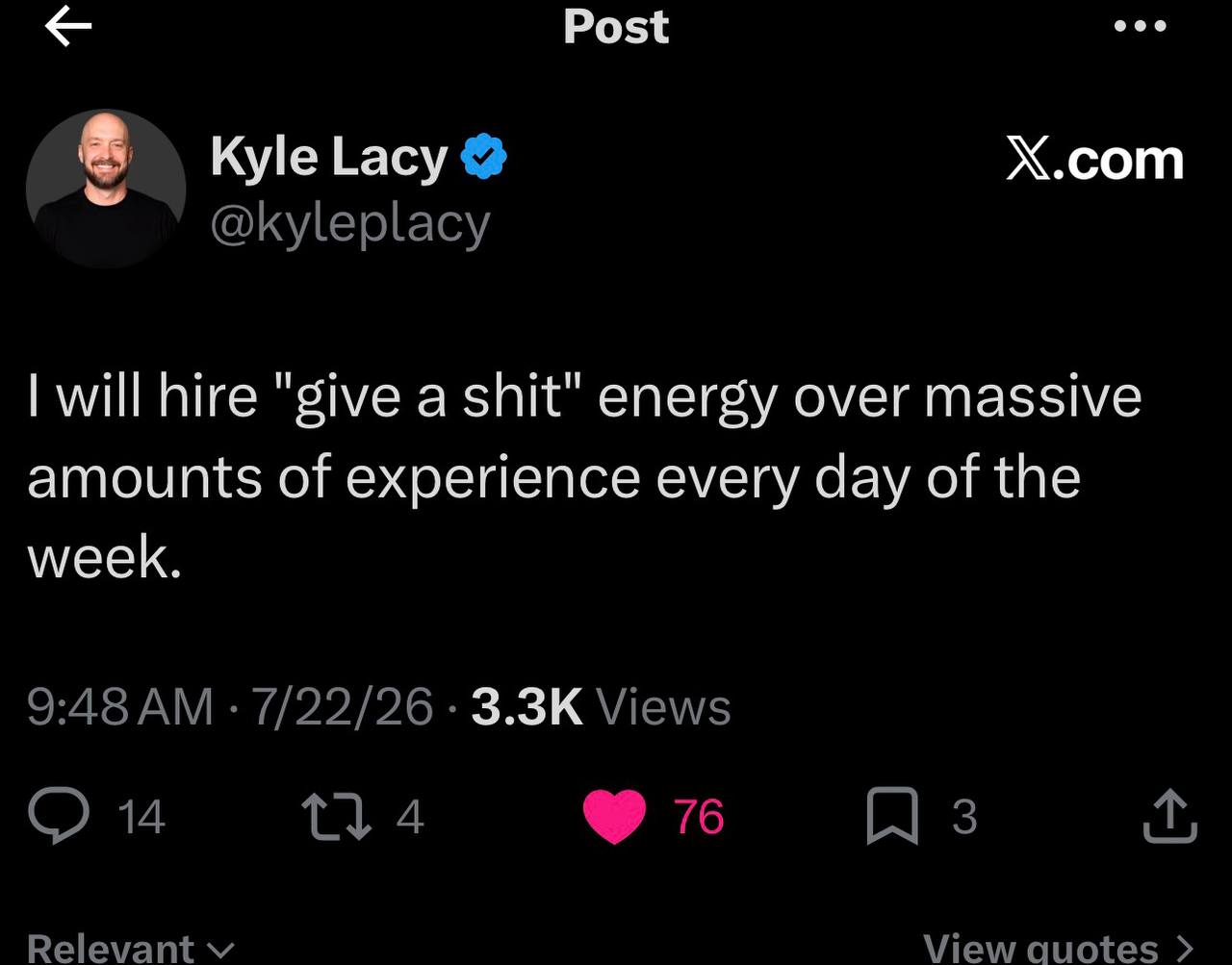
I saw this tweet by Kyle on X and had one of those immediate reactions.
Fuck yeah.
Because if everybody had this mentality, you would have super teams of powerful individuals getting shit done.
Experience matters. I am not going to pretend it does not. Reps matter. Scar tissue matters. Pattern recognition matters. There are things you only learn by doing the work, breaking things, fixing them, getting humbled, and coming back better the next day.
But I would rather hire somebody who gives a shit than somebody with 20 years of experience who gives zero fucks. Every time.
Caring Is Not Soft
When I say someone gives a shit, I do not mean they are nice. I do not mean they have a good attitude in some fake corporate way. I do not mean they smile through broken processes and pretend everything is fine.
I mean they care enough to keep pushing until they figure it out.
They ask questions. They stay curious. They try things. They search. They talk to other people. They come back with, “I tried X, Y, and Z, and none of it worked. Here is what I am seeing.”
That is different from showing up empty-handed and complaining.
The people who give a shit are relentless in their curiosity. They want to provide real solutions. They care about the client outcome. They care about the team. They care about doing solid work without cutting corners.
That kind of caring is not soft. It is operational.
Workplace research has been saying versions of this for a long time, even if it uses cleaner language. Conscientiousness keeps showing up as one of the personality traits most consistently tied to job performance. That means dependability, persistence, follow-through, and responsibility matter in real work.
That is what I mean by giving a shit.
The useful version is not performative hustle. It is care converted into behavior. The person follows through. They notice when something is off. They do not disappear when the problem gets annoying. They communicate before the small issue becomes the team’s problem.
That matters even more now because the tools keep changing. AI can make a mediocre person faster at producing mediocre work. It can also make a curious person dangerous in the best possible way.
Curiosity is one of the ways caring shows up.
The Wrong Kind Of Experience
The dangerous experienced person is not always lazy. Sometimes they are worse than lazy.
They are certain.
They roadblock before they try. Their default answer is, “We can’t do that.” Not because they tested it. Not because they brought evidence. Not because they are protecting the work from a real risk.
Because they already decided.
They are not collaborating. They are not curious. They are protecting what they think they know.
You can feel it pretty quickly. There is a vibe to people who care about doing solid work. There is also a vibe to people who think they know everything and do not want to be bothered.
One pushes the work forward.
The other drains the room.
Good Pushback Is Different
I do not want a team full of people who agree with everything.
That is not the point.
Good pushback is valuable. Good pushback usually sounds like:
“Yes, and here is what we should watch for.”
Or:
“Yes, but I have seen this fail before, and here is why.”
That is experience doing its job.
The person is not shutting the door. They are adding context. They are bringing scar tissue into the room without using it as a weapon.
The good kind of complaining sounds like:
“Hey, I think this could speed up the process.”
“I think this part could be improved.”
“I talked to a few other developers, and we are seeing the same thing.”
That kind of complaint is not negativity. It is signal. It means somebody is paying attention. They care enough to notice the friction, talk to the team, and bring it forward before it becomes normal.
Sometimes the person who gives a shit is the one complaining. Because they can see what is broken.
The Cost of Not Caring
When some people give a shit and other people do not, it brings down the whole team.
Morale drops.
Speed drops.
Confidence drops.
The people who care start looking around wondering why they are carrying the standard for everyone else. That is how strong teams get weaker. Not all at once. A little at a time.
It also changes what people are willing to say out loud.
If the people who care keep raising issues and nothing happens, eventually they stop raising issues. They learn that speaking up is expensive and staying quiet is easier. That is when a team starts losing its learning loop.
Amy Edmondson’s work on psychological safety is useful here. Teams learn better when people can speak up, ask questions, admit mistakes, and take interpersonal risks without getting punished for it. That does not mean everyone gets to complain forever with no responsibility. It means problems surface early enough to matter.
That is the environment where the people who give a shit can actually help.
Without that, your best people either shut down or leave.
For me, this is close to nonnegotiable.
There are levels to it, obviously. People have bad days. People get burned out. People get confused. People get stuck in bad workflows. That matters.
Some people do not give a shit.
Some people want to give a shit, but they are frustrated, blocked, or confused.
Those are not the same person.
The second person can be worked with. You talk. You listen. You make it safe enough for them to be honest. You ask what is getting in the way. Sometimes the problem is not the person. Sometimes the workflow is broken.
Big shock: communication solves a lot.
I would rather have overcommunication than undercommunication almost every time.
Struggle Leaves Evidence
Everybody gets stuck.
That is not the signal.
The signal is what they do next.
The person who is trying but struggling usually shows evidence of effort. They searched. They tried something. They asked someone. They tested a path. They came prepared with what they already attempted.
They might not have the answer yet, but they can show the work.
The checked-out person comes with nothing.
No attempts. No notes. No “I tried this.” No “I talked to them.” No “here is where I got stuck.”
Just a complaint.
That difference becomes obvious pretty quickly.
This is where I think managers need to be careful.
Do not punish the person who is struggling if they are showing effort. That person might need context, support, clarity, or a better process.
But do not confuse empty complaining with struggle.
If someone never brings attempts, never asks real questions, never follows the thread, and never shows curiosity, that is not a workflow issue forever. At some point, that is the work telling you who they are.
As a manager, I always tried to give people the benefit of the doubt. You have to break down walls. You have to earn trust. You have to make space for someone to be honest without worrying that you will weaponize it later.
But open-minded does not mean blind.
Sometimes it is genuinely not a good fit.
Hire for the Next Move
I do not care that much about years on a resume.
I care how someone thinks.
I care how they communicate.
I care whether they are excited, curious, and interested in being part of a team.
I care whether they can get the job done reasonably well inside real constraints.
I care whether they know when to ask for help.
I care whether they obsess over the work or get lost in minutia that does not matter.
Ask better questions:
What happened on a project that went wrong?
How did you solve it?
How do you communicate with your team?
How do you communicate with managers?
How do you communicate with clients?
What do you do when you get stuck?
What have you tried before asking for help?
I also want to know how they talk about other people. Do they blame everyone around them, or can they take ownership? Can they explain a failure without turning it into a courtroom defense?
Technical skill matters too, obviously. But skill without communication can still slow everyone down. Skill without humility can make every decision harder than it needs to be. Skill without care can create more cleanup than progress.
If you have ever played sports, you know this feeling. You can tell who is a good teammate. You can tell who does the little things when the team is busy. You can tell who wants to win together and who only wants credit when things go well.
Work is not that different.
The best teams are not built only from the most experienced people in the room.
They are built from people who care enough to learn, communicate, improve, help, and keep going when the work gets hard.
And the work is hard.
It is getting harder and easier at the same time.
AI makes some things faster. Tools get better. Information is everywhere. But the human part is still the hard part. Judgment. Communication. Trust. Taste. Teamwork. Caring enough to use the tools well instead of hiding behind them.
That is why this matters.
Outside of family, work is where people spend a huge amount of their time.
I want to spend that time with people who give a shit.
People who are passionate. People who are curious. People who communicate. People who make the product, the team, and the client experience better.
Experience matters.
But experience without care turns stale.
Experience with care is different.
That is the person who has seen enough to protect the work, but still has enough curiosity to improve it. They have boundaries without becoming a roadblock. They have opinions without becoming impossible. They have scar tissue without making everyone else bleed for it.
Give me the person who gives a shit.
We can build from there.
Research Notes
– Barrick and Mount, *Personnel Psychology*, 1991: conscientiousness consistently predicted job performance across occupational groups. – Amy Edmondson, *Administrative Science Quarterly*, 1999: psychological safety supported team learning behavior, which helped explain team performance. – Beal, Cohen, Burke, and McLendon, *Journal of Applied Psychology*, 2003: group cohesion and performance are meaningfully connected. – Ericsson, Krampe, and Tesch-Romer, *Psychological Review*, 1993: expertise comes from focused effort, feedback, and sustained improvement, not time alone. – Crant, *Journal of Applied Psychology*, 1995: proactive behavior connected with objective job performance.