AI exposed the standard problem
AI did not kill quality. It exposed who never had standards in the first place.
That is the part a lot of people do not want to say out loud, because it is easier to blame the tool than admit the operator never knew how to judge the work.
The current AI panic around code has this weird shape to it. Half the room is screaming that software is dead. The other half is acting like every problem can be solved by prompting harder and shipping whatever comes back.
Both sides are exhausting.
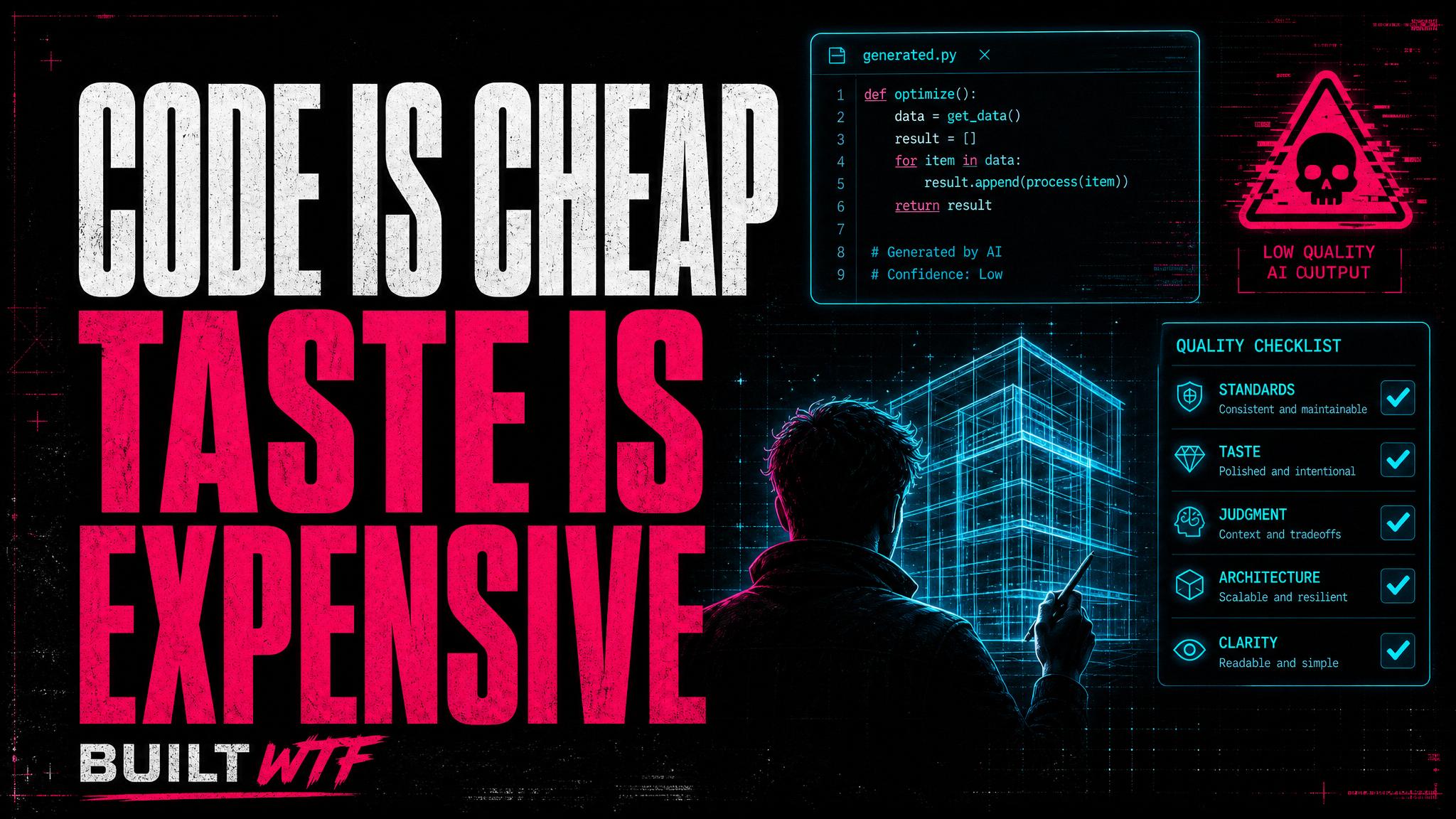
Code got cheaper. That part is real.
Taste got expensive.
That is the part people keep skipping.
Not taste like fancy design taste. I mean taste as in judgment, standards, restraint, and the ability to look at a thing and know whether it works. Does it belong? Will it hold up? Does it solve the real problem, or does it just perform competence in a demo?
AI made it easier to produce code. It did not make it easier to know what code should exist.
It did not magically give people architecture sense. It did not hand out twenty years of debugging scars. It did not give taste to people who never developed any.
AI did not lower the bar. It made weak standards easier to see.
The virus is not AI
The mind virus is the idea that because code is cheaper, code matters less.
That is wrong.
Cheap does not mean meaningless. It means the constraint moved.
For a long time, writing the code was expensive enough that the act of production filtered people. If you could not build it, you could not really flood the system with bad work at scale. You could still make a mess. Plenty of people did. But there was friction.
Now the friction is lower.
You can generate a feature in minutes. You can scaffold a plugin, a landing page, an automation, a script, a custom dashboard, whatever. The gap between idea and first draft collapsed.
That is incredible. It is also dangerous if the person holding the tool cannot tell the difference between first draft and finished work.
That is where this gets ugly.
A lot of people are not using AI as leverage. They are using it as a permission slip to stop thinking.
They ask for code. They get code. They paste the code. They ship the code. Then when something breaks, they blame AI like the tool snuck into production behind their back.
No.
You shipped it. You accepted it. You decided it was good enough, even if the decision was passive.
That is operator failure.
The machine can generate the mess, but the human still accepts responsibility for shipping it.
Code got cheap, judgment did not
I have been building, fixing, rewriting, untangling, and troubleshooting things for around twenty years.
That does not make me automatically right. It does mean I have seen enough broken systems to know what bad decisions smell like before they fully rot.
There is a kind of pattern recognition you only get from implementation. You learn how small shortcuts become permanent architecture. You learn how a clever workaround turns into a business dependency. You learn how plugins, custom code, hosting, content models, user behavior, client expectations, and maintenance all collide in the real world.
You learn that the hard part is rarely writing the first version.
The hard part is knowing what to leave out. The hard part is knowing when the prompt gave you something plausible but brittle. The hard part is knowing when the fastest path today becomes the thing everyone curses six months from now.
The hard part is knowing when not to build.
That is the part AI does not do for you.
It can help. I use it all the time. I am not anti-AI. That would be stupid. These tools are changing what one person can do, and I am probably more excited about that than most people.
But excitement is not the same as abdication.
The tool can generate options, explain tradeoffs, refactor, write tests, find edge cases, and accelerate almost every layer of the work if you know how to direct it. But it cannot care about your standard more than you do.
That is still on you.
Use AI to increase options, not to outsource judgment. The review layer is where the work gets real.
Most people never learned critique
This is the real gap.
Not prompting.
Critique.
A lot of people never learned how to look at work and make it better. They learned how to react. They learned how to like or dislike. They learned how to say “looks good” because they wanted the meeting to end.
They learned how to nitpick surface details because deeper critique made them uncomfortable.
But critique is a skill.
It is not being negative. It is not dunking on the work. It is not pretending you are smarter than the person who made it.
Real critique asks better questions:
Does this solve the actual problem?
What does this assume?
Where does this break?
What happens when the content changes?
What happens when the client uses it wrong?
What happens when traffic spikes, the API changes, the plugin updates, or the team forgets why this choice was made?
What did we make simpler?
What did we make harder?
What are we signing ourselves up to maintain?
That is the work now. Or at least, that is the work for anyone serious.
AI can give you ten solutions. Critique tells you which one deserves to survive.
AI can write code. Taste tells you whether the code belongs in the system.
AI can move fast. Standards tell you when to slow down.
Critique is the filter between output and work that can actually survive contact with reality.
The demo is not the product
This is where a lot of tech bro AI pandering falls apart.
The demo culture is out of control.
Someone prompts a tool, generates a little app, slaps a caption on it, and suddenly the lesson is “developers are cooked.”
Relax.
A demo is not a product. A prototype is not an architecture. A green checkmark is not a standard.
A thing that works once, under perfect conditions, with fake data, no users, no edge cases, no maintenance plan, and no future business pressure is not proof that the job is done. It is proof that you made something appear on a screen.
That is not nothing. But it is not everything.
The real world is where the bill comes due.
The real world has weird inputs. Half-finished requirements. Old systems nobody documented. Business constraints. Timeline pressure. Human behavior. Copy that breaks the layout. Teams that need to understand the thing after you leave.
This is why implementation experience still matters.
Not because old developers deserve a trophy for being old. Because real work leaves scars, and scars are data.
If you have been the person cleaning up broken systems at 11 PM, you start reviewing work differently. You stop being impressed by cleverness alone. You start asking what this thing will cost later.
You start caring about boring stuff because boring stuff is usually where stability lives: naming, structure, dependencies, documentation, permissions, reversibility, content editing, failure modes, ownership.
That is not sexy. That is why it matters.
The demo is allowed to be impressive. The product has to be useful after the applause stops.
Restraint is a superpower now
When everything is easier to generate, restraint becomes more valuable.
That sounds backwards until you live inside the tools for a while.
The problem is no longer “can we make something?”
The problem is “should this thing exist in this form?”
Every generated feature has a tail. Every automation has a failure mode. Every new dependency becomes part of the operating surface. Every clever abstraction creates one more thing someone has to understand later.
Cheap code can still create expensive systems.
That might be the sentence people need tattooed on their foreheads before they start vibe-coding core business logic into production.
You can generate a lot of code quickly and still make the whole business slower. You can automate a process and make it harder to trust. You can ship more and improve less.
That is the trap.
Output is not the same as progress. Velocity is not the same as direction. A pile of generated code is not a product strategy.
This is where taste matters.
Taste keeps capability from turning into clutter. Taste says no. Taste cuts the clever part because the boring part is more durable. Taste protects the user from your excitement.
Taste is not decoration.
Taste is operational discipline.
Restraint is not anti-technology. It is what keeps capability from turning into clutter.
The standard has to live somewhere
The standard cannot live inside the tool. It has to live in the operator.
That does not mean one person has to know everything. Nobody does. It means someone has to own the judgment layer.
Someone has to decide what good means. Someone has to review the work with enough context to catch the quiet failures. Someone has to understand the business, the user, the system, and the maintenance reality well enough to say, “This is impressive, but it is not right.”
That sentence is going to matter more and more.
AI will keep making impressive things easier.
Impressive is cheap now. Useful is harder. Durable is harder. Coherent is harder. Right is harder.
And that is why the people with judgment are not getting replaced by AI. They are getting more leverage.
The people who can critique, direct, review, simplify, architect, and decide are about to separate from the people who can only produce.
Production is abundant. Judgment is scarce.
That is the market now.
Production is abundant. Judgment is scarce. That is where the real leverage moved.
I am not scared of cheap code
I am not scared that code got cheap. I am relieved.
A lot of the annoying friction is going away. Good. I have spent enough years fighting stupid technical drag to appreciate a better tool when one shows up.
What worries me is not AI writing code.
What worries me is people shipping things they do not understand. Managers who think a demo equals a team. Developers who stop reviewing because the model sounds confident. Businesses using AI to scale sloppiness instead of scale quality.
That is the danger.
Not the tool. Negligent use of the tool.
AI did not kill quality. It exposed who had quality standards and who was mostly borrowing the appearance of quality from slower processes.
Now the guardrails are thinner. The excuses are weaker. The work shows your judgment faster.
That can be brutal. It can also be great.
Because if you actually care about standards, this is a ridiculous moment. You can move faster without lowering the bar. You can explore more options without committing to all of them. You can build, test, throw away, refine, and ship with a feedback loop that would have sounded insane a few years ago.
But only if you stay awake.
Only if you keep reviewing.
Only if you keep your taste sharp.
Only if you remember that cheap code still needs expensive judgment.
Code got cheap, taste got expensive.
Good.
Maybe that is exactly the correction we needed.
Cheap code does not make taste optional. It makes taste more expensive.