Everybody wants a moat now
Everybody wants a moat now. Founders talk about moats. Agency owners talk about moats. SaaS people talk about moats. AI people talk about moats. Everybody wants the thing that makes them hard to copy, replace, or compete with.
Usually the conversation goes straight to technology: proprietary systems, AI workflows, data, automation, distribution, or some secret operating system behind the curtain. I get why people want that. It sounds clean. You can diagram it on a whiteboard.
But most of us are not sitting on an untouchable technical advantage. We have tools, taste, experience, scars, a stack of subscriptions, and a bunch of opinions about how the work should be done. A lot of that can be copied.
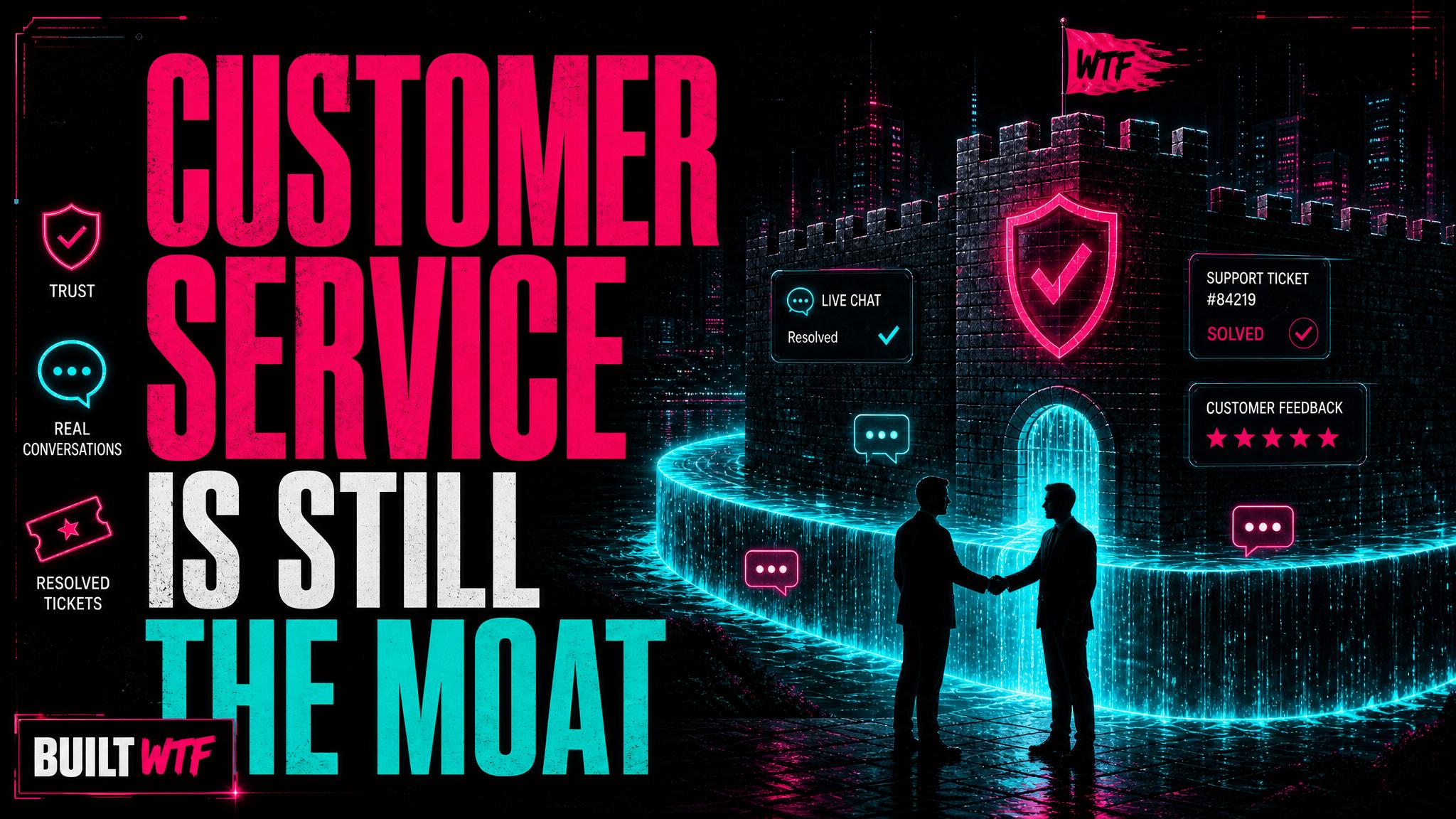
Someone can buy the same tools, watch the same videos, build a similar workflow, prompt the same model, and steal the surface area. So I keep coming back to the uncomfortable answer: the customer service moat is still one of the hardest advantages to fake.
Not customer service in the corporate script sense. I mean how you think, how you care, how you explain things, and how you keep trying to get the client to the outcome, even when the path is ugly.
The moat is not the tool. It is the standard you keep when the work gets annoying.
The customer service moat nobody wants to talk about
Customer service is not sexy. Nobody wants to brag about answering questions clearly, sending the update, telling the client what changed, or staying calm when the whole thing gets annoying.
But businesses change. Tools change. Platforms change. Search changes. Ads change. AI changes. Everything around the work keeps moving. The one thing that does not change is that people want to be treated like they matter.
That is not soft. That is the job. People remember who made them feel stupid. They remember who disappeared. They remember who overpromised, underdelivered, and then acted like the client was the problem for asking questions.
They also remember who explained the situation, told the truth, gave them options instead of excuses, and cared about the outcome. That is hard to copy because it is not tactical. It is a standard.
A tactic can be copied in an afternoon. A standard has to survive Tuesday.
Customer service is not support tickets
A lot of people hear customer service and think support tickets. Too small. Customer service is not only responding when something breaks, being polite in an inbox, or sending a canned response that says, “We appreciate your patience.”
Customer service is the experience of working with you. It starts before somebody buys. Can they understand what you do, who you help, and what the process looks like? Do they feel like you are helping them make a good decision, or do they feel like they are being pushed through a funnel?
Then it continues during the work. Do you explain what is happening? Do you tell them what you need? Do you set expectations early and say the uncomfortable thing before it becomes expensive?
Then it continues after the work ships. Do you check whether the thing is working? Do you make sure they know how to use it? Do you leave them better equipped than when they came in?
That is customer service. It is not a department, a mood, or a line item. It is how the business behaves when nobody is clapping for it.
Customer service is the operating system. It is how the business acts before, during, and after the sale.
Client education is part of the work
This is the part I keep thinking about: if I do the work but the client does not understand enough to make better decisions, did I really do the job? Maybe technically. But not fully.
Client education is part of the work. That does not mean turning every project into a seminar. Clients hire you because they need help, not because they want a lecture on your process. But they should understand enough.
Enough to know why one path is better than another. Enough to know what tradeoff they are making. Enough to know when something is a real problem and when it is noise. Enough to stop chasing shiny nonsense because some guy online made it sound urgent.
This is where a lot of experts get lazy. They hide behind complexity, use jargon like a wall, and make the client feel dumb for asking normal questions about their own business. I hate that.
If somebody trusts you with their money, time, and some piece of their business, they deserve more than “trust me.” They deserve to understand what they are approving. They deserve to know what could go wrong. They deserve your judgment, not just your output.
That does not mean the client gets to drive every decision. Part of the job is pushing back. Sometimes the most useful thing you can say is, “I understand why you want that, but it does not solve the real problem.” That is service too. Not obedience. Service.
Teach enough for the client to make better decisions. Do not confuse service with letting them drive into a wall.
Outcomes matter, even when you cannot fully control them
Here is the hard part: I cannot always control the outcome. Nobody can. You can do good work and still miss because the timing was bad, the offer was weak, the market shifted, the client did not execute, or the customer did not respond the way everybody hoped.
Anybody who guarantees every outcome is either lying or selling something with almost no variables. But not controlling the outcome does not mean I get to stop caring about it.
That is where a lot of service work gets weird. People protect themselves by shrinking the job down to the deliverable: I built the thing, I sent the file, I launched the page, I did what was in scope.
Fine. Scope matters. Boundaries matter. But there is a big difference between delivering the task and working toward the goal. Clients can feel that difference.
They can tell when you are doing the minimum. They can tell when you are more interested in being right than being useful. They can tell when you are protecting yourself instead of trying to help them win. They can also tell when you are actually invested.
You ask better questions. You point out the risk. You challenge the bad assumption. You explain the tradeoff. You follow up. You keep moving toward the outcome, even when the path gets annoying.
Trust compounds when people see that you still care after the clean part of the project is over.
The one-person agency trap
Here is the problem with “my moat is me.” It can become a cage.
At first, it feels like a strength. Clients want you. They trust you. They like how you think. They like how you explain things. They like that you can see the whole board and connect dots other people miss.
That is valuable. It is also dangerous. If every decision, explanation, client relationship, quality check, hard conversation, and rescue mission has to run through you, then you do not have a durable business. You have a very demanding job with extra paperwork.
The thing that made you different becomes the thing that keeps you stuck. Clients wait on you. The work waits on you. The business waits on you. The standards live in your head, so nobody else can fully meet them.
That is not noble. It can feel noble because you are carrying everything, solving the problems, saving the day, and making sure the work is right. But carrying everything forever is not the same as building something strong.
If the moat only works when you personally touch everything, it is not a moat yet. It is a bottleneck with good intentions.
Scaling judgment, not ego
The answer is not to care less. People hear scale and start stripping the humanity out of the business. More automation. More templates. More handoffs. More distance from the outcome. That kind of scale is easy to build and miserable to experience.
The better move is to scale the judgment. Productize how you think, communicate, educate, and define a good outcome. Not so everyone talks like you. That would be weird. So the standard can survive without you personally touching every single thing.
What do we explain before a project starts? When do we push back? What promises do we refuse to make? What tradeoffs do we always name out loud? What does done actually mean? How do we communicate bad news, follow up after launch, and know if the work did what it was supposed to do?
These are not glamorous questions. They are the business. A real moat is not the founder being unusually intense forever. A real moat is when that intensity becomes a repeatable standard.
Scale the judgment, not the ego. The goal is not to clone yourself. The goal is to make the standard durable.
The tools will change. The obligation will not.
The tools are going to keep changing. AI will get better. Search will keep shifting. Websites will evolve. Automation will keep eating the repetitive parts. Platforms will rise, decay, and get replaced. Some of that is exciting. Some of it is exhausting. Most of it is both.
But none of it removes the obligation. If somebody trusts you with their business, you owe them more than a deliverable. You owe them attention, honesty, judgment, and the respect of explaining what you are doing and why it matters.
You owe them the courage to say, “I do not think that is the right move,” when saying yes would be easier. You owe them follow-through. That is the part that survives every cycle.
Customer service is still the moat because most people do not want to do it when it gets inconvenient. They want the optics of caring without the burden of care. They want the relationship without the responsibility. But the responsibility is the thing.
The moat is what happens when the client is confused, worried, frustrated, ambitious, wrong, half-right, overwhelmed, or standing at the edge of a decision they do not fully understand. Do you treat them like a ticket? Or do you treat them like a person?
That is the work. Then comes the harder work: building a business that can keep doing that without making one person the machine. Not the flashy part. The part that lasts.
The durable customer service moat is care turned into behavior. Not vibes. Not slogans. Behavior.