David Brooks used a line in The Atlantic that has been stuck in my head:
When intelligence is plentiful, volition is valuable.
That is the whole thing.
AI made intelligence feel cheap. Not worthless. Cheap. You can ask a model for a plan, a draft, a summary, a strategy, a block of code, a checklist, a second opinion, a counterargument, or a dozen headline options before your coffee gets cold. That is wild. It is also where people start lying to themselves.
Because when the output shows up fast, it gets tempting to confuse speed with skill. You type in a basic prompt, get something that looks decent, and call it productivity. Sometimes that is useful. Sometimes it is fake work wearing a nice jacket.
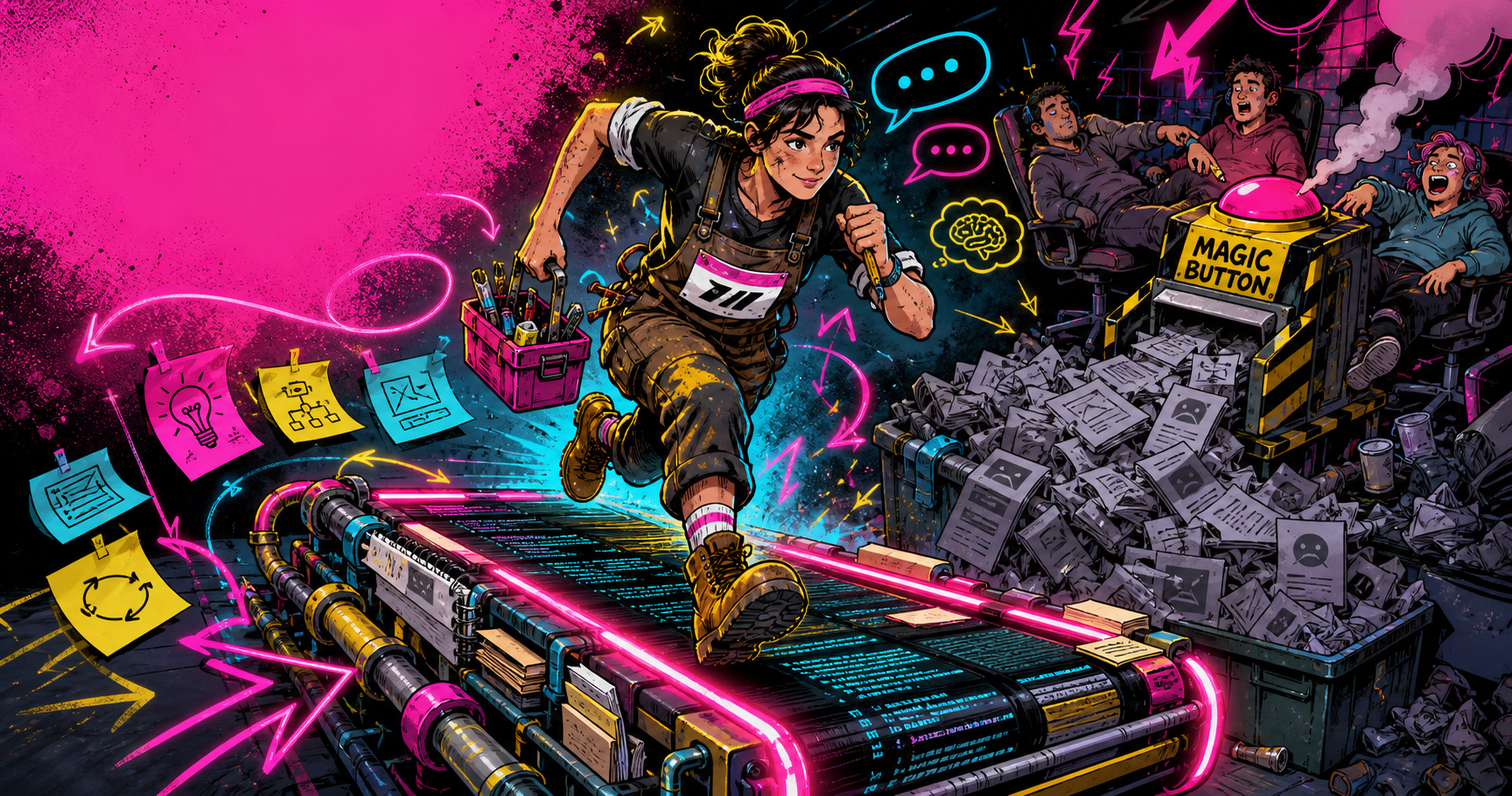
The marathoners win. Not because they suffer more, but because they stay with the work long enough to become dangerous.
The people who win in this next phase are not the people who figure out how to avoid the work. They are the people who get energized by the work. The ones who see faster feedback and think, good, now I can take more reps. Now I can push harder. Now I can build the thing I never had time to build.
Key takeaways
- AI makes intelligence easier to access, which makes volition more valuable.
- Faster output is only useful if you keep your standards high.
- Taste still comes from reps, review, mistakes, and pattern recognition.
- Brain fog and exhaustion are real. Tools can help, but they should support the rep, not replace it.
- Business owners do not need a magic button. They need clearer direction, stronger foundations, and better questions.
- The people who use AI to take harder reps will beat the people using it to avoid reps.
Three Camps Are Forming
There are a lot of ways to sort people in the AI age, but this one feels useful: productive passengers, reluctant optimizers, and mental marathoners.
Productive passengers use AI like a ride. They want the tool to take them somewhere. They are not evil. They are not stupid. Sometimes they are doing exactly what they should do. If the job is low stakes, repetitive, and boring, fine. Let the machine carry more of it.
But passenger mode has a ceiling. If you never learn the terrain, you are always dependent on the driver.
Reluctant optimizers are the people who do not really want AI in the work, but they also do not want to get left behind. They use it because the world is moving. They automate a little, summarize a little, draft a little, and quietly hope the whole thing calms down.
I get that more than I probably should. New tools can be annoying. They break your rhythm. They make everyone around you say insane things like “ten times faster” while you are still trying to figure out whether the output is even true.
Then there are the mental marathoners. These are the people who get energy from the work itself. They are not trying to use AI to disappear from the process. They are trying to use it to go further into the process.
They do not ask, “How can I do nothing?” They ask, “What can I finally attempt now?” That is a completely different posture.
Faster Can Make You Sloppier
This is the part nobody wants to admit because it ruins the sales pitch. AI can make your work worse. Not because the tools are bad. A lot of the tools are already good, and they are getting better fast. The problem is what speed does to your standards.
When something used to take three days and now takes thirty minutes, your brain starts treating the first decent output like a finished product. You got the dopamine hit. The document exists. The page has words on it. The code compiles. The plan sounds smart enough.
Ship it.
That is where the rot gets in, because the real work usually starts after the first output.
What is missing? What is generic? What did it misunderstand? Where did it sand off the most interesting part? Where did it give you the safe answer because you asked a lazy question? Where did it sound polished but hollow?
This is why I get annoyed when people talk about AI like the prompt is the whole job. A basic prompt is not craftsmanship. It is a vending machine order. Sometimes you get lucky and the bag drops. That is not a system.
Taste Still Takes Time
I have been building websites, writing copy, fixing systems, working with business owners, and making technical decisions for a long time. That matters.
Not because experience makes me right all the time. It does not. Experience mostly gives you better instincts for when something smells wrong. You can feel when the structure is weak. You can see when the copy is too smooth. You can tell when the design looks fine but does not understand the business. You can spot when a tool gave you the average answer to a specific problem.
That is taste.
Taste is not magic. It is not something you either have or do not have. Taste is pattern recognition built from reps, mistakes, feedback, frustration, and the occasional painful moment where someone better than you points at your work and says, “No, look again.”
AI did not give me taste. AI gives me more ways to iterate on taste. That distinction matters.
If you already have direction, the tools help you move faster. If you know what good feels like, the tools give you more material to shape. If you have standards, the tools let you test more versions before you settle.
But if you have no taste, no patience, no direction, and no willingness to review the work, faster output just helps you make more mediocre stuff. Congratulations. You automated the wrong part.
The Long Way Still Matters
This is where plumbing keeps coming back into my head. Nobody becomes a plumber because they watched a video and bought a wrench.
You learn the trade by showing up. You ride along. You ask questions. You crawl under things. You make mistakes while somebody more experienced is close enough to stop you from creating a disaster. You learn why something works, not just which part goes where.
That is apprenticeship. The repetition is the point. The long way teaches you what the shortcut is doing.
That same principle shows up in software, agency work, writing, design, operations, and pretty much anything worth being good at. The shortcut only helps when you understand what it is skipping.
If you do not understand the long way, the shortcut turns into theater. You look busy. You generate artifacts. You make folders full of output. But under pressure, you do not know what matters.
AI is full of this right now. People are producing more. More docs. More posts. More code. More automations. More ideas. More noise. Some of it is useful. A lot of it is people confusing the existence of output with the presence of judgment.
The marathoner does not make that mistake. The marathoner knows reps are not glamorous. Reps are how your eyes get better.
Brain Fog Is Not Laziness
There is a line I want to be careful with here. This is not a macho post about grinding yourself into dust.
I have real experience with brain fog. I know what it feels like when the idea is there but the words are not. I know what it feels like when your brain is fried at the end of a long day, or after a big push that compressed weeks of work into one stretch.
That is not the same thing as laziness.
Sometimes tools help you keep going because they catch the rough shape before it disappears. They help organize the mess. They give you something to react to when blank space feels heavier than it should. That can be a lifeline. It can also be a trap. The difference is intent.
Using AI because your brain is tired and you need a scaffold is smart. Using AI because you refuse to think clearly about what you want is lazy. Using AI to recover the thread is smart. Using AI to avoid building the skill is lazy. Using AI to help you take another rep is smart. Using AI to pretend you already took the rep is lazy.
That is the line. It is not anti-AI. It is anti-fake productivity.
Business Owners Still Have To Care
This matters a lot for business owners. There is no magic button.
There are better tools now. There are faster workflows. There are ways to build systems that used to be out of reach for small teams. There are things I can do in a day now that would have taken weeks before. That is real.
But the foundation still matters. You still need to know what you are trying to build. You still need to understand your customer. You still need to care about the offer. You still need to make decisions. You still need to review the work. You still need to ask better questions.
If you skip that, AI will not save you. It will expose you.
The laziest version of AI adoption is when somebody throws a vague prompt at a tool, accepts the first answer, and acts like they have a strategy. No, you have a document. That is different.
A strategy has judgment in it. It has tradeoffs. It has a point of view. It knows what not to do. It understands the business well enough to filter the output. That filtering is the work.
The Serious People Get More Dangerous
Here is the hopeful part. If you are already the kind of person who puts in the reps, AI is not a threat to your craft. It is a multiplier.
Not automatically. Not magically. But seriously.
You can attempt harder work. You can test ideas faster. You can build systems around your taste. You can create tools that help you iterate when you are tired. You can compare directions before committing. You can turn one rough thought into ten useful angles, then still have the standards to throw eight of them away.
That is power.
The people who were already curious get more curious. The people who were already building get bigger systems. The people who were already asking questions ask better ones. The people who were already hard to compete with get harder to compete with.
That is what I mean by marathoners. Not people who fetishize suffering. People who stay in the work long enough for the work to change them.
They build resolve. They build resilience. They build taste. Eventually they start doing things other people cannot do because other people kept looking for the exit ramp.
The Work Still Wins
I do not want AI to make me lazy. I want it to make me more capable. That is the difference.
I want the tools to help me get to the work I could never reach before. The systems I knew should exist. The ideas sitting in the notebook. The experiments that used to require too much setup. The questions I did not have enough time or energy to chase.
That is exciting. But it only works if I stay honest about the work.
The prompt is not the craft. The output is not the judgment. The shortcut is not the apprenticeship. The tool is not the taste.
When intelligence is plentiful, volition is valuable. So the question is not whether AI can help you move faster. It can. The question is what you do with the speed.
Some people will use it to check out. Some people will use it to look productive. The marathoners will use it to go further.
And they are going to win.