Build the Tool That Makes the Mess Smaller
Most of the time, the real problem is not that you need another app.
The real problem is that something in your work keeps creating the same kind of friction over and over again, and nobody has taken ownership of fixing it. That is where a lot of useful products actually come from. Not market maps. Not pitch decks. Not a founder pretending the world was waiting for another dashboard. Just repeated pain.
That is what happened with FitFO.
If you do enough website work, client onboarding, redesign planning, or infrastructure cleanup, you start hearing the same questions on repeat. Who owns the domain? Who controls DNS? Where does email actually route? What happens when the contact form fires? Is Cloudflare in front of the site, or does somebody just think it is? Are there subdomains, redirects, analytics tags, call tracking scripts, booking tools, and old lead flows hanging off the property that nobody documented?
Usually, yes.
That is the work a lot of people skip because it is not the sexy part. But that is also the work that can punch you in the mouth on launch week. It is easy to get hypnotized by the visible part of a project: new layout, better copy, cleaner code, stronger UX. I care about that stuff too. But if you do not understand the operating environment you are stepping into, you are not really managing the project. You are guessing your way through it.
A lot of good products start when somebody gets tired of repeated friction. The best early tools usually do not begin as big visions. They begin as pain relief.
FitFO came from operational pain, not startup theater
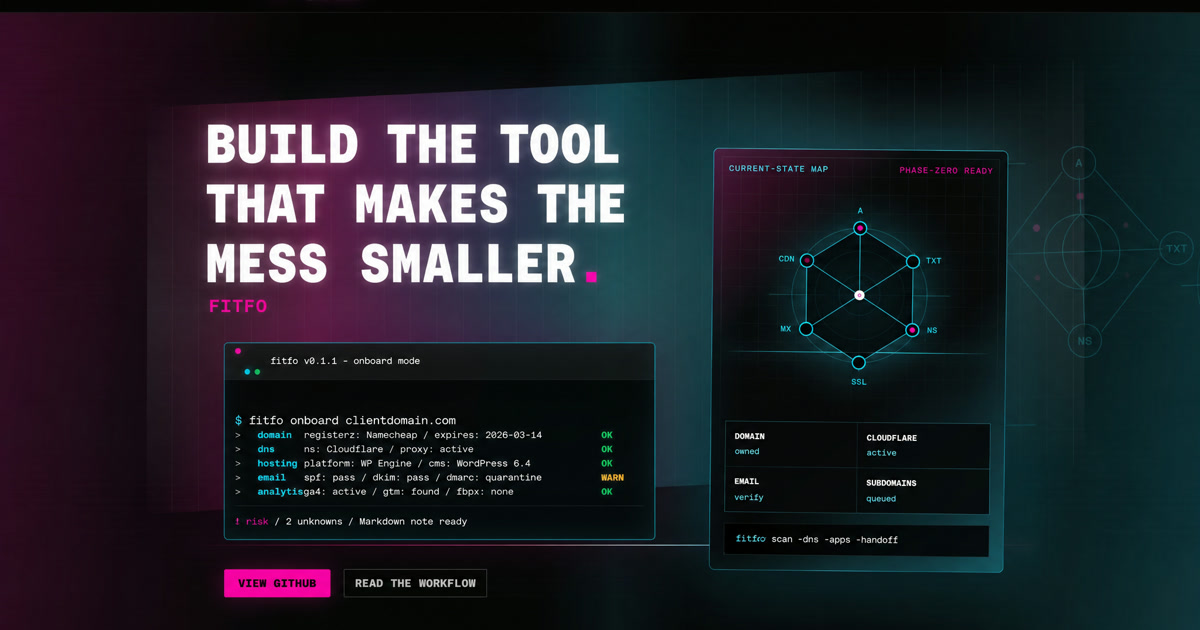
FitFO is a simple idea. You point it at a domain and it starts helping you figure out what is actually there: registrar clues, DNS, hosting signals, CMS detection, email safety, analytics, tags, common subdomains, redirects, canonical behavior, infrastructure warnings, access questions, and launch risks.
Not because the tool magically knows everything. It does not. But it can infer a lot. It can surface public signals. It can keep you from walking into a first call half blind. It can turn a fuzzy handoff into a real working checklist.
That matters because a lot of projects do not fail from lack of talent. They fail from weak discovery. People still treat redesigns like blank slates when they are almost never blank slates. They are inherited systems with history, buried decisions, forgotten dependencies, weird redirect behavior, third-party tools nobody remembered to mention, and risk hiding behind innocent-looking logins.
FitFO was built to surface that kind of mess faster. Not to replace judgment. Not to replace strategy. Not to act like a robot consultant. Just to help a builder, strategist, or operator get to the truth sooner.
A good tool should make a smart person faster. It should not pretend to make thinking unnecessary.
Good products usually start as pain relief
This is the part I think a lot of people miss. The best early product ideas are usually not brilliant in the abstract. They are useful in the specific.
You run into the same friction often enough that eventually you stop saying somebody should build that and start building it yourself. That is a much healthier starting point than trying to reverse-engineer a market category before you have solved anything real.
You do not need a five-year roadmap to build something useful. You need pattern recognition. You need enough reps to know which problems are annoying once and which problems are structural. That is where the leverage is.
FitFO did not come from sitting around asking what kind of SaaS product the world needs. It came from seeing the same onboarding confusion, the same infrastructure blind spots, and the same avoidable launch risk often enough that building a tool became the obvious move.
That is a very different energy. One is startup cosplay. The other is problem ownership. I trust the second one a lot more.
The useful question is not what can I launch. It is what friction has shown up often enough that I should stop tolerating it and build a cleaner way through it.
Building is broader than software now
When I say builder, I do not just mean engineers. I mean anybody learning how to shape work: developers, designers, agency owners, operators fixing broken workflows, even tradespeople building better systems for estimates, photos, handoffs, follow-up, or field communication.
If you are trying to reduce friction and create better systems, you are building. That is why this shift matters.
More people can build useful things now. Not because craft stopped mattering. Because access to execution changed. The bottleneck is less about whether you can technically produce something at all and more about whether you can identify the right problem, frame it correctly, and tighten the result until it is actually useful.
That is still work. Real work. And honestly, it is the part that matters most. I am less interested in whether someone can generate a bunch of code quickly than whether they can tell the difference between a toy and a tool.
The future does not belong to people who can make more noise. It belongs to people who can reduce confusion, remove drag, and build something that actually carries weight.
Build your own tools where the work keeps bleeding
One thing that changed for a lot of builders is not just speed. It is permission. You do not need to wait for a full company, a roadmap committee, or some perfect stack before you solve a real problem sitting right in front of you.
Sometimes you just need enough clarity to say this part is stupid, this part is expensive, and this part keeps happening often enough that I am done tolerating it. That is the moment where useful tools start. Not when you are trying to look like a founder. When you are trying to stop wasting time.
A lot of people should probably build your own tools sooner than they think. Not giant platforms. Not ten-feature software fantasies. Small sharp tools that take repeated friction out of the workflow.
- a scanner that turns a vague website handoff into a real starting point
- an upload flow that turns a chaotic pile of client photos into something clean and usable
- an internal checklist engine that keeps critical setup from living in somebody’s head
- a quoting helper that removes repetitive admin drag
- a field handoff workflow that packages the right information before it gets dropped on the next person
The shape is not the point. The repeated pain is.
A few signs you are probably looking at tool territory: the same kickoff questions keep getting asked because nobody documented the answers, the same files keep showing up broken or unlabeled, the same access problem keeps stalling real work at the worst possible moment, the same cleanup step keeps eating an hour that should have taken ten minutes, or the same launch risk keeps getting discovered way too late.
That is not just inconvenience. That is workflow debt. And workflow debt compounds exactly like the other kind. It drains energy, blurs accountability, and makes otherwise good people look sloppier than they really are.
Build your own tools around the pain that has already proven it deserves attention. That is usually a better bet than chasing a trend from across the room.
Pelican is a different product with the same instinct
I have another product in private beta right now called Pelican. Different shape. Different job. Invite only for now.
It is not a CLI tool. It is a practical upload product built around a very unglamorous but very real problem: client photos are usually a mess. Wrong format. Huge files. Private metadata still attached. No clear upload path. No clean place to review what came in. No reliable way to turn those assets into something ready for the web, GBP, and the other places they actually need to go.
Same pattern, though. Repeated friction. Real operational drag. Build the thing that makes the drag lighter.
That is why I think these two products belong in the same conversation. Not because they do the same thing. Because they came from the same philosophy. Look at the chaos honestly. Find the part that keeps wasting time, creating risk, or making good work harder than it should be. Build there.
If the same ugly handoff, cleanup step, discovery problem, or upload mess keeps showing up in real work, that is usually product signal, not just annoyance.
Start with the pain in front of you
I think a lot of people still overcomplicate the beginning. They think building has to start with scale. It does not. It can start with one ugly recurring problem, one broken handoff, one fragile workflow, or one part of the job that keeps stealing time and attention.
That is enough. In a weird way, that is actually better. Because now you are not building from fantasy. You are building from contact. That tends to produce better products, better judgment, and better questions. You learn what matters because you are already close enough to the pain to feel it.
That is true whether you are building software, a service business, an internal process, a field workflow, or a better way to run your life. The pattern is the same: pay attention, name the friction, reduce the chaos, then do it again.
That is a much better foundation than waiting for the perfect idea. The perfect idea usually shows up wearing work clothes anyway. It looks like irritation. It looks like repetition. It looks like a problem you are finally tired of tolerating.
Build the tool that makes the mess smaller. That is where a lot of the good stuff starts.