
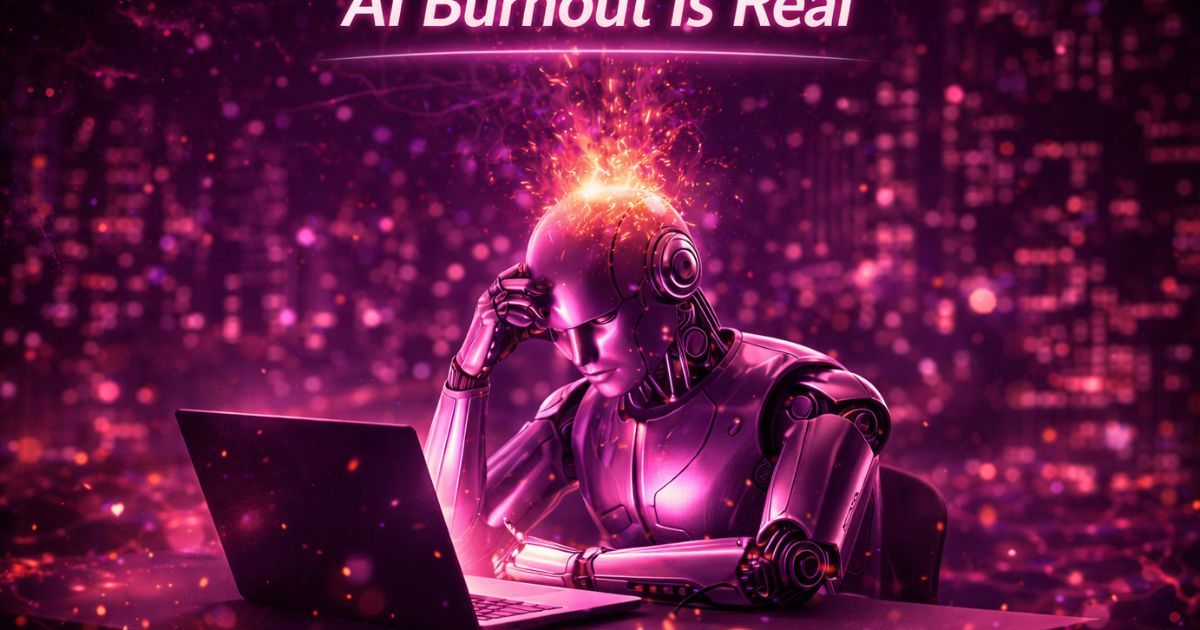
AI Burnout Is Real
I think a lot of people are about to learn this the hard way.
You can absolutely burn out with AI. In some ways, I think AI makes burnout easier. Not because the work gets harder. Because the governor is gone.
There used to be natural friction in the day. Your hands got tired. Your brain got tired. The backlog got bigger than your available hours and that was that. You stopped because reality stopped you.
Now reality doesn’t stop you the same way. You can keep going. You can push through one more draft, one more site, one more automation, one more idea, one more rabbit hole, one more night where you tell yourself you’re just tying up loose ends.
The tools keep saying yes. Your brain is the only thing left saying no. And if you’re built like me, you don’t always listen when it whispers.
AI doesn’t remove limits. It removes visible limits. That is not the same thing. Your output can triple. Your nervous system does not.
The Last Three Weeks Felt Like a Blur
I’ve been running hard for weeks. Day job. Agency work. Plumbing school. Family. Experiments. Writing. Building. Fixing. Learning. Trying to leave every system, every project, every corner of life a little better than I found it.
That sounds noble when you say it out loud. It also turns into a trap real fast.
Because when AI enters the picture, the old excuses disappear. The thing that would’ve taken four hours might now take forty minutes. The thing that needed a second person might now just need a clean brief and a little oversight. The thing you kept putting off because you didn’t have time suddenly feels doable.
And then everything starts feeling doable.
That is the danger.
Not that AI makes impossible work possible. It makes too much possible at once. It widens the aperture so fast that if you don’t have ruthless focus, you’ll start treating every good idea like an obligation.
I’ve felt that in my bones lately. Not because I hate the work. Quite the opposite. I love it. I love clients. I love building. I love the feeling of seeing something half-formed in my head and turning it into something real. I love systems. I love language. I love shipping. I love being useful.
And that might actually be worse.
Most burnout stories are about people who hate their work. This one isn’t. Sometimes burnout comes from loving the work so much that you never let yourself stop.
The Old Friction Used to Protect Us
People talk about friction like it’s always bad. It’s not. Sometimes friction is what saves you from your own wiring.
Before AI, there were physical and logistical constraints built into the day. You could only write so much. You could only research so much. You could only build so much without context switching yourself into mush. The pace of production had a ceiling because the manual nature of the work imposed one.
That ceiling wasn’t always fun. But it was honest.
Now the friction is lower everywhere. You can get rough drafts faster. Summaries faster. options faster. Code faster. Refactors faster. Research faster. You can move from idea to artifact with almost no dead air.
Which sounds amazing, and it is amazing, until you realize the dead air was sometimes where your brain caught up to your ambition.
That little pause between effort and output used to help you make decisions. It forced prioritization. It forced tradeoffs. It forced a little maturity into the process.
Take too much friction away and something weird happens. You don’t become calm and efficient. You become tempted. Every side quest starts looking legitimate. Every half-baked thought starts looking like an executable plan. Every unfinished system starts begging for one more improvement.
And if you’re someone who genuinely enjoys solving problems, congratulations. You just handed gasoline to your favorite personality flaw.
Lower friction means you need stronger filters. If the tools accelerate execution, your standards for what deserves execution have to get sharper too.
You Can Do 3x the Work. You Don’t Get 3x the Brain.
This is the part I keep coming back to.
AI can absolutely help you do three times the work. Maybe more. But your brain didn’t scale at the same rate. Your body didn’t. Your sleep needs didn’t. Your emotional bandwidth didn’t. Your decision fatigue sure as hell didn’t.
So what happens? The production capacity goes up. The human processing capacity stays mostly the same. That mismatch is where burnout lives.
And because the output looks so impressive from the outside, it’s easy to mistake overload for momentum.
You feel productive because a lot is happening. A lot is shipping. A lot is moving. But internally, the stack trace is ugly. Too many open loops. Too many threads. Too many things competing for the same finite pool of attention.
At a certain point the issue isn’t whether you can keep producing. You can. The issue is whether the quality of your thinking starts to degrade while the machine around you still looks efficient.
That’s what makes AI burnout sneaky. It doesn’t always look like collapse. Sometimes it looks like output. Sometimes it looks like success. Sometimes it looks like a guy getting more done than ever while quietly turning himself into an overheated laptop.
Volume can hide damage. When the tools keep helping you produce, you can miss the fact that your mind is getting noisier, flatter, and more brittle underneath it all.
My Kind of Burnout Is Complicated
I don’t burn out because I’m disengaged. I burn out because I’m fully engaged.
I care. A lot. Probably too much if we’re being honest.
I care about clients. I care about doing clean work. I care about improving systems. I care about shipping things that actually help. I care about making the next version better than the current version. I care about building a life that feels integrated instead of fragmented.
There is a decent chance that part of what makes me good at what I do is also the thing that cooks me if I don’t manage it.
Because when you care this much, AI doesn’t just give you leverage. It gives you permission to keep going. It says, sure, let’s improve that too. Sure, let’s clean up that workflow while we’re here. Sure, let’s tackle the thing you’ve been avoiding. Sure, let’s spin up another experiment. Sure, let’s make the blog post better. Sure, let’s tighten the copy. Sure, let’s fix the process behind the thing behind the thing.
And none of those are bad ideas in isolation.
That is what makes this so hard to talk about. Burnout doesn’t always come from obviously bad decisions. Sometimes it comes from a stack of individually reasonable decisions that collectively become absurd.
One more improvement. One more cleanup. One more pass. One more idea. One more thing to leave better than you found it.
Do that across everything all at once and now you’re not operating from principle. You’re operating from compulsion with a productivity layer wrapped around it.
“Leave it better than you found it” is a great principle. Applied to everything, every day, without limits, it becomes a recipe for exhaustion.
AI Is Not the Villain Here
I want to be clear about something. This is not an anti-AI post.
I’m grateful for these tools. Deeply. I could not have done the amount of work I’ve done lately without them. They have helped me think, organize, write, build, debug, and move with a level of leverage that felt impossible not long ago.
AI is not the problem. In my case it has often been the reason things got done at all.
The problem is that leverage without boundaries turns your strengths into liabilities. The better the tool, the more honest you have to be about your own tendencies. If you’re scattered, AI can multiply scattered. If you’re avoidant, AI can help you hide in fake productivity. If you’re obsessive, AI can help you build an entire cathedral around one small idea while the rest of your life waits in the parking lot.
The tool amplifies the operator. That’s the deal.
So no, I don’t think the answer is backing away from AI like it’s dangerous by default. I think the answer is building a healthier relationship with the power it creates.
That means fewer side quests. Tighter priorities. More deliberate stopping points. Better filters around what actually matters right now.
Not because discipline is sexy. Because without it, the machine will happily help you grind yourself into powder.
The Real Skill Might Be Stopping
I think one of the big skills of the next few years is going to be knowing when to stop.
Not when the work is impossible. When it is still very possible. When the tools are humming. When the output is flowing. When you can feel ten more useful things you could do if you just kept going another hour.
That is the moment that matters.
Anybody can stop when they’re blocked. The challenge is stopping when you’re effective.
Stopping because your brain matters too. Stopping because tomorrow needs a version of you that can still think in layers. Stopping because the people in your house deserve more than whatever scraps are left after the machine has had its fill.
I don’t say that from some enlightened mountaintop. I’m saying it because I am learning it in real time and not always elegantly.
I still love the work. I still love the tools. I still believe this changes everything. I also think some of us need to admit that the new bottleneck isn’t production. It’s self-regulation.
If AI removed the natural stopping points from your day, you need to put some back on purpose. End times. focus windows. rules for side quests. Some friction is healthy.
I’m Not Pulling Back. I’m Paying Attention.
I don’t want less ambition. I want cleaner ambition.
I don’t want to do less meaningful work. I want to stop treating every possible improvement like a moral duty. I don’t want to abandon the tools. I want to use them in a way that doesn’t quietly tax every part of my life.
There’s a difference between expanding your capacity and overrunning your circuits. I think a lot of us are still learning where that line is.
So if you’ve been feeling weird lately, fried but productive, grateful and overwhelmed at the same time, excited by what AI makes possible while also noticing your brain feels smoked, you’re not crazy.
This is real.
AI burnout is real. Especially for the people who care the most, love the work, and finally have tools that let them run at the speed they’ve always wanted.
The answer isn’t fear. It’s awareness. It’s focus. It’s a few good boundaries. It’s remembering that more capacity is not the same thing as infinite capacity.
The tools can help you do more.
They cannot tell you when enough is enough.
The next layer of AI maturity is not just better prompts or better agents. It is knowing your own limits well enough to keep leverage from becoming self-destruction.